QIS Construction News
HVAC Duct Leakage - Pressure Test Ductwork
With the advent of a more energy conscious consumer, builders are spending hundreds to thousands of dollars providing new homes with latest and greatest energy efficient features. However, recent studies have shown that for mere pennies on the dollar, builders can substantially increase the overall efficiency of new homes by simply tightening ductwork construction.
Leaky ductwork often accounts for 10 to 30 percent of total heating and cooling costs. If duct leakage is 20% of total airflow, the efficiency of the cooling system can drop as much as 50%. Duct leakage also lowers heating and cooling capacity thereby reducing equipment life. And while the increase in energy costs as a result of leaky ducts can be significant, protecting the health and safety of the building occupant is the most important reason to insist on a tight duct construction.
Air leaking into or out of the HVAC system can dramatically affect humidity control, condensation potential, indoor air quality, energy consumption, and occupant comfort.
Air leaks on the return side of the HVAC system can cause the home to become pressurized because more air is being supplied to the home than is being removed by the return air ducts. Pressurization can lead to dust filtration and wasted energy costs. The HVAC system is the primary source of dehumidification during warm weather. Leaks in ductwork on the return air side of the unit that are outside the thermal envelope can pull hot, humid air from the attic into the HVAC system. This can cause a burden on the system’s ability to dehumidify and cool the air in the home.
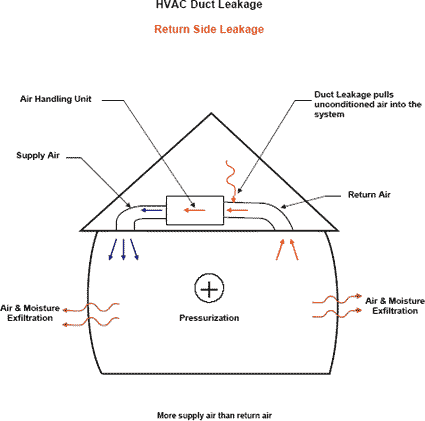
Air leaks on the supply side of the HVAC system can cause the home to become depressurized because less air is being supplied to the home than is being removed by the return air ducts (see diagram). Depressurization can pull dust, pollen, mold spores, carbon monoxide from cars, and other contaminants into the home through any air leaks in the building envelope. Depressurization can also pull air down through chimney flues and vent pipes of combustible appliances at a rate that can cause the pilot flame to be extinguished. If this occurs, natural gas or combustion byproducts can be pulled into the home. The depressurization caused by supply air duct leakage pumps conditioned air out of the system causing significant loss of energy.
Airtight duct construction is one of the keys to providing a quality heating and cooling system. Such systems assist in making the home’s environment more healthy and comfortable and lead to greater energy efficiency.
There is only one way to make sure that ductwork has been thoroughly sealed... TEST IT. A simple pressure test can measure the airtightness of the air distribution system and helps hold installers to a high standard of quality.
Pressure testing is not a new concept in home construction. Plumbers have their work pressure tested on every job, and the test forces them to get it right, meaning NO leaks. But when plumbing leaks there is an immediate consequence... things get wet. Air leakage on the other hand seldom causes immediate trouble. Instead, homeowners gradually become aware of comfort problems, high utility bills and decreasing indoor air quality over time. A duct tightness test is the only way to identify defects in advance.
Qualified Inspection Services through its affiliate company Energy Smart can provide third party residential inspection and testing services designed to help builders construct more energy efficient homes. To find out how our services may benefit your company, please contact us today.